

You open a message, ask a simple question, and get four letters back: IDTS. What exactly is the other person trying to tell you?
IDTS means “I don’t think so.” In chat, texting, and social media conversations, people use this abbreviation to express doubt, mild disagreement, uncertainty, or a casual negative response.
It can mean something close to “probably not,” but context matters. A friendly “IDTS 😂” feels quite different from a cold “IDTS.” during an argument.
Understanding the IDTS meaning in chat isn’t difficult once you know how tone changes its message. Here’s how people actually use it.
IDTS Meaning in Chat – Quick Definition
IDTS stands for “I Don’t Think So.”
It is an informal texting abbreviation people use when they doubt something, disagree with someone, or believe something probably won’t happen.
Think of IDTS as a quick response somewhere between “maybe not” and “no.”
Someone who writes IDTS usually isn’t claiming complete certainty. They’re expressing what they currently think or believe.
Simple breakdown:
Each letter represents one word:
- I = I
- D = Don’t
- T = Think
- S = So
So:
IDTS = I Don’t Think So
Both IDTS and lowercase idts can appear in casual messages. The meaning normally stays the same.
Example sentences:
Here are a few natural examples:
Friend: “Do you think Jake is coming tonight?”
You: “IDTS. He said he was busy.”
Friend: “Will we finish this before dinner?”
You: “IDTS 😅”
Person A: “Is that restaurant still open?”
Person B: “IDTS, but check online.”
Friend: “Do you think our team will win?”
You: “IDTS lol.”
Notice the pattern. IDTS often expresses a belief rather than a confirmed fact.
Origin & Background
IDTS belongs to the wider world of texting abbreviations and internet slang.
Shortened expressions became especially useful when people wanted faster ways to communicate through text messages and online chats. Instead of writing an entire sentence such as “I don’t think so,” a person could simply type four letters.
The abbreviation follows the same basic idea as familiar shortcuts such as:
- IDK: I don’t know
- IMO: In my opinion
- TBH: To be honest
- BRB: Be right back
- TTYL: Talk to you later
IDTS isn’t limited to traditional SMS messages. You may now encounter it in private messages, group chats, gaming conversations, social media comments, and direct messages.
Its appeal is simple. Four letters can communicate an entire thought.
Real-Life Conversations (How People Actually Use It)
Learning the definition is easy. Understanding how IDTS sounds in a real conversation is more useful.
Here are four common situations.
1. WhatsApp Chat
Alex: “Are you coming to dinner tonight?”
Sam: “IDTS, I still have loads of work.”
Sam isn’t necessarily making a dramatic rejection. The message simply suggests that coming to dinner seems unlikely.
Adding an explanation also makes the response warmer.
2. Instagram DM
Friend: “Do you think I should post this photo?”
You: “IDTS 😅 I like the other one better.”
Here, IDTS communicates an opinion rather than a factual answer. The emoji also softens the disagreement.
3. TikTok Comments
User 1: “This trend is going to stay popular forever.”
User 2: “IDTS 😂”
In a comment section, IDTS can sound playful, skeptical, or slightly sarcastic. The surrounding conversation usually reveals the intended tone.
4. Text Message
Friend: “Are we still meeting at 7?”
You: “IDTS. Something came up. Can we do tomorrow?”
This example shows why adding context helps. A standalone “IDTS” might leave the other person wondering what happened.
Emotional & Psychological Meaning
The literal definition of IDTS stays simple, but its emotional tone can change.
Text messages don’t provide facial expressions or vocal cues. As a result, readers often interpret meaning through context, punctuation, emojis, and their relationship with the sender.
What it often signals:
Uncertainty:
You don’t believe something is likely, but you aren’t completely certain.
Mild disagreement:
You have a different opinion without necessarily wanting an argument.
Soft rejection:
IDTS can sometimes work as a less definite alternative to saying “no.”
Skepticism:
You aren’t convinced that a statement or prediction is correct.
Dismissiveness:
In tense conversations, a bare “IDTS” can occasionally sound abrupt.
Compare these:
“IDTS 😊 maybe another day?”
and
“IDTS.”
The literal meaning is identical. The emotional impression isn’t.
That’s why context matters so much with texting slang.
Usage in Different Contexts
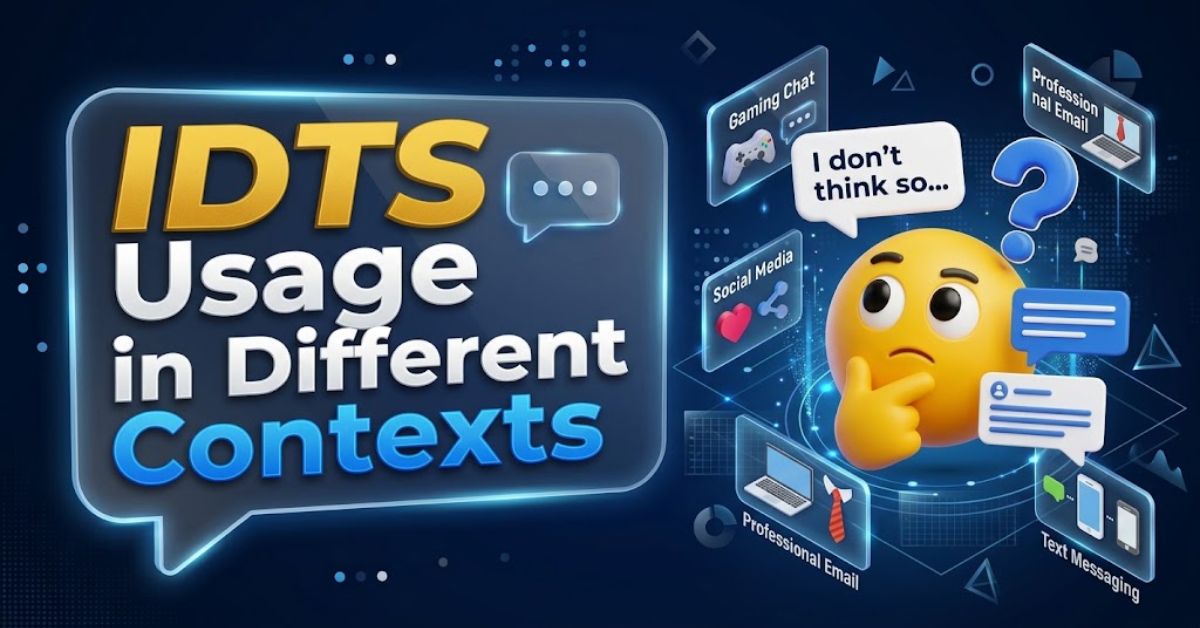
IDTS works naturally in some conversations and awkwardly in others. Before using it, consider your audience and the situation.
1. Social Media
IDTS fits easily into casual social media conversations.
You might see it in:
- Instagram DMs
- TikTok comments
- Snapchat conversations
- WhatsApp messages
- Group chats
- Gaming chats
- Informal online discussions
For example:
“Is this really the best song on the album?”
“IDTS 😂”
The reply expresses casual disagreement without requiring a long explanation.
2. Friends & Relationships
Among friends, IDTS can sound completely natural.
Friend: “Think we can eat this entire pizza?”
You: “IDTS, but I respect the ambition 😂”
Romantic or emotional conversations require more care.
Imagine someone asks:
“Do you still want this relationship?”
Responding with only:
“IDTS.”
could sound cold or hurtful.
In sensitive conversations, writing a complete response usually communicates your feelings more clearly.
3. Work or Professional Settings
IDTS is generally better suited to informal communication than formal business writing.
You might occasionally see it between coworkers who already communicate casually. However, avoid it in important emails, reports, client messages, applications, or formal workplace discussions.
Instead of:
“IDTS this strategy will work.”
Write:
“I don’t think this strategy will work as expected.”
Or:
“I’m not sure this is the best approach.”
Clear language usually sounds more professional and leaves less room for misunderstanding.
4. Casual vs Serious Tone
| Situation | What IDTS May Communicate | Better Choice |
|---|---|---|
| Chatting with friends | Casual disagreement | IDTS |
| Making weekend plans | Probably not | IDTS + explanation |
| Social media comment | Doubt or skepticism | IDTS |
| Relationship discussion | Possible rejection | Full sentence |
| Work email | Too informal | Professional wording |
| Sensitive conversation | May sound dismissive | Clear, thoughtful reply |
A useful rule is simple: the more serious the conversation becomes, the less useful abbreviations become.
Common Misunderstandings
Although IDTS has a straightforward meaning, people can still interpret it incorrectly.
1. Thinking It Means “I Don’t Know”
IDTS and IDK aren’t interchangeable.
IDK = I don’t know
IDTS = I don’t think so
IDK means you don’t know the answer. IDTS means you have an opinion or expectation, usually leaning toward “no.”
For example:
“Is Chris coming?”
“IDK” means you don’t know whether Chris is coming.
“IDTS” means you believe Chris probably isn’t coming.
That small difference matters.
2. Assuming It’s Always Rude
IDTS isn’t automatically rude.
Among friends, it can sound perfectly casual. Tone becomes more important when the conversation is serious, emotional, or tense.
Compare:
“IDTS 😂”
with:
“IDTS.”
One can feel playful. The other might feel more final or blunt.
3. Using It in Sensitive Situations
Short replies aren’t always appropriate.
Avoid relying on IDTS alone when someone is:
- Sharing personal feelings
- Asking an important relationship question
- Discussing a serious problem
- Seeking emotional support
- Requesting a detailed explanation
A few extra words can prevent unnecessary confusion.
4. Misreading Tone
Text strips away voice, facial expressions, and body language.
That makes a short abbreviation easy to misread.
If you’re unsure whether someone meant IDTS playfully, sarcastically, or seriously, look at the messages around it. Emojis, punctuation, previous conversations, and your relationship with the sender provide useful clues.
Comparison Table
Several texting expressions look similar but communicate slightly different ideas.
| Term | Meaning | Typical Tone | Common Use |
|---|---|---|---|
| IDTS | I don’t think so | Doubtful, casual | Mild disagreement |
| IDK | I don’t know | Neutral | Lack of knowledge |
| IDT | I don’t think | Casual | Beginning or shortened thought |
| IMO | In my opinion | Neutral | Sharing an opinion |
| Nope | No | Direct, informal | Clear rejection |
| Maybe not | Possibly no | Gentle | Uncertain refusal |
| Probably not | Likely no | Neutral | Negative prediction |
The biggest distinction is certainty.
“Nope” usually sounds more definite. “IDTS” leaves more room for uncertainty.
Variations / Types of IDTS
People often combine IDTS with other slang, words, and emojis to change its tone.
IDTS lol
Adds humor or makes disagreement feel lighter.
IDTS tbh
Means “I don’t think so, to be honest.”
IDTS rn
Means “I don’t think so right now.”
IDTS bro
Adds a casual, friendly feel.
IDTS sorry
Makes a negative response sound more considerate.
IDTS 😅
Can suggest awkwardness, hesitation, or gentle disagreement.
IDTS 😂
Often makes the message sound humorous or playful.
IDTS maybe later
Rejects something now while leaving another possibility open.
Lowercase “idts” is also common. Capitalization usually doesn’t change the basic definition, although punctuation and formatting can affect how the message feels.
How to Respond When Someone Uses IDTS
There’s no single perfect reply. Match your response to the conversation.
Casual Replies
For everyday conversations, keep things simple:
- “Okay, no worries.”
- “Got it!”
- “Fair enough.”
- “Maybe next time.”
- “Alright, sounds good.”
Funny Replies
If you’re joking with a friend, you could respond with:
- “That confidence though 😂”
- “You didn’t even hesitate 😭”
- “Wow, convincing argument 😂”
- “Guess we’ll find out!”
Humor works best when you already know the other person is joking.
Mature / Confident Replies
If someone disagrees with your opinion, you don’t need to turn it into an argument.
Try:
- “Fair enough.”
- “I see your point.”
- “Thanks for being honest.”
- “We’ll see what happens.”
- “That makes sense.”
These replies keep the conversation relaxed and respectful.
Private / Respectful Replies
If the topic is personal, respond with more care:
- “That’s okay. I understand.”
- “No pressure.”
- “Thanks for telling me.”
- “Would you rather talk about it?”
- “We can figure something else out.”
The goal isn’t to find a clever comeback. It’s to understand what the person means and respond appropriately.
Regional & Cultural Usage
Internet slang travels across borders quickly. Still, familiarity with English abbreviations can vary by community, age group, platform, and individual communication habits.
Avoid assuming that everyone from a particular country or culture will interpret IDTS exactly the same way.
Western Culture
IDTS may appear in casual English-language texts, DMs, comments, and group chats. Friends who already use internet abbreviations are more likely to understand it immediately.
In professional or formal situations, writing the complete phrase remains clearer.
Asian Culture
English-language internet slang is also used across many Asian online communities, particularly where people regularly communicate in English.
However, usage varies enormously between countries and individuals. Some people may prefer a complete phrase because it sounds clearer or more polite.
Middle Eastern Culture
IDTS can also appear in English-language digital conversations across Middle Eastern communities.
As elsewhere, familiarity depends more on the individual, platform, age, language habits, and relationship than geography alone. In respectful or formal exchanges, the full phrase may communicate your meaning more clearly.
Global Internet Usage
Online communication crosses regional boundaries every day.
Someone may encounter IDTS while:
- Gaming with international players
- Watching TikTok content
- Reading Instagram comments
- Messaging friends abroad
- Participating in an online community
The safest approach is to consider the audience. If someone may not recognize the abbreviation, simply write “I don’t think so.”
Clarity beats clever shorthand.
FAQs
1. What does IDTS mean in texting?
IDTS means “I don’t think so.” People use it in texts and chats to express doubt, mild disagreement, uncertainty, or a likely “no.”
2. Is IDTS rude?
Not necessarily. IDTS is usually casual, but a short reply can sound blunt in serious or emotional conversations.
3. Can I use IDTS in formal writing?
Generally, no. Use the full phrase “I don’t think so” or a more professional alternative in formal communication.
4. What’s the difference between IDTS and IDK?
IDTS means “I don’t think so,” while IDK means “I don’t know.” IDTS expresses an opinion or expectation, whereas IDK indicates a lack of knowledge.
5. How do I make IDTS sound polite?
Add context or warmer wording, such as “IDTS, sorry!” or “IDTS 😅 maybe another time.”
6. Is IDTS commonly used today?
IDTS still appears in informal texting, chats, DMs, comments, and other online conversations, although usage varies between people and communities.
7. Can IDTS hurt someone’s feelings?
It can if the situation is emotional or sensitive. Adding an explanation or using the complete phrase can make your response sound more thoughtful.
Conclusion
The IDTS meaning in chat is simple: “I don’t think so.” People use this texting abbreviation to communicate doubt, skepticism, mild disagreement, uncertainty, or a casual negative response.
Its real meaning, however, comes from context.
“IDTS 😂” between friends can feel playful. “IDTS.” during an argument may sound dismissive. The same four letters can create a different impression depending on punctuation, emojis, the topic, and your relationship with the other person.
Use IDTS freely in relaxed conversations when you know the other person will understand it. For professional, serious, or emotional discussions, write your thoughts more clearly.
Sometimes four letters are enough. Sometimes the full sentence says it better.

Axel Miles is a writer and language researcher at Magazine Zeto, focused on explaining text meanings, slang, acronyms, and online expressions. Axel creates clear, practical guides that help readers understand modern digital language, with a focus on accuracy, context, and easy-to-follow explanations for everyday communication.