

Have you ever received a text that simply says “ard” and wondered whether the person agreed, felt annoyed, or made a typo? You’re not alone. Internet slang can turn an ordinary word into something that looks completely unfamiliar.
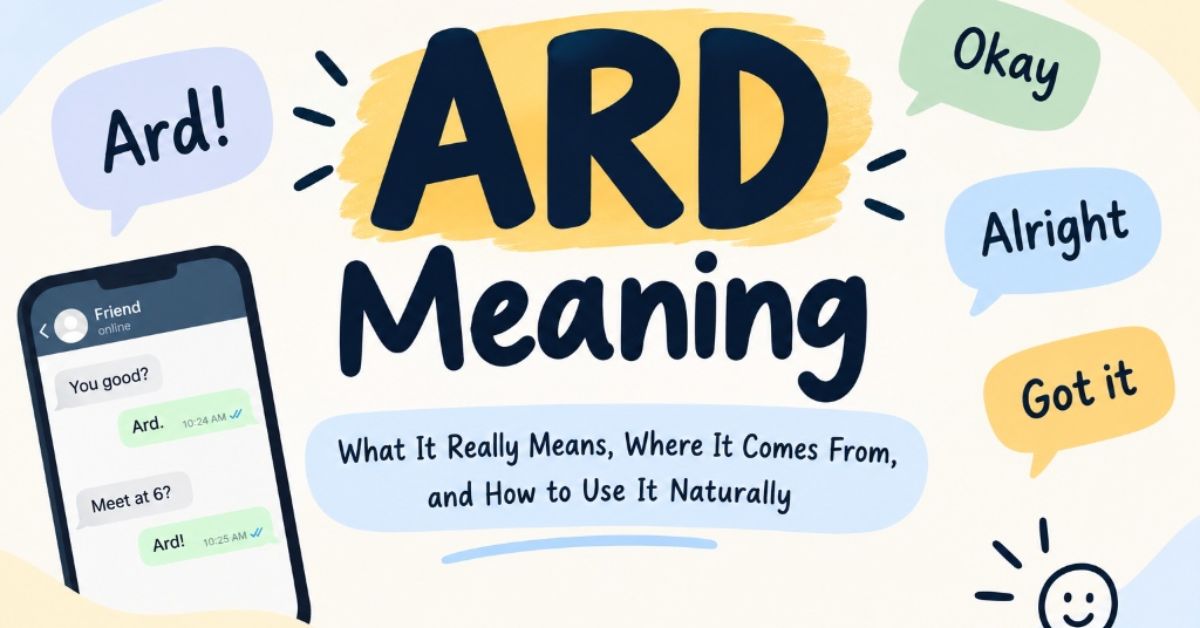
The ARD meaning in texting is usually “alright” or “okay.” People use it in casual conversations to agree with someone, acknowledge a message, or confirm a plan. The expression has a notable connection to Philadelphia slang and appears in informal digital communication.
However, understanding the definition is only half the story. The conversation, relationship, and surrounding words can influence how the reply feels. Let’s explore where “ard” comes from, how people use it, and what you can say when someone sends it to you.
ARD Meaning: Quick Definition
ARD is informal slang for “alright.” It commonly expresses agreement, acknowledgment, acceptance, or understanding in casual conversations.
Simple meaning:
When someone types “ard,” they usually mean one of the following:
- Okay.
- Alright, I understand.
- Sounds good.
- That’s fine with me.
- Got it.
The exact interpretation depends on the situation. For example, if your friend asks whether you can meet at 6 p.m. and you reply “ard,” you’re confirming the plan.
Examples:
Here are a few everyday examples that show how people use the term.
| Conversation | Meaning of ARD |
|---|---|
| “Meet me outside at 5.” “Ard.” | Okay, I’ll meet you there. |
| “I’ll send the notes tonight.” “Ard, thanks.” | Okay, I understand. |
| “We can watch a movie tomorrow.” “Ard, sounds good.” | I agree with the plan. |
| “You okay?” “Ard, I’m good.” | I’m alright. |
Quick takeaway: Think of “ard” as a relaxed version of “alright.” It’s useful in informal conversations, but standard wording works better when clarity and professionalism matter.
Origin & Background
The story behind “ard” is closely connected to regional speech and local slang. Dictionary.com identifies the expression with Philadelphia youth slang, where people use it as a shortened form of “alright.” Its history also appears in the online slang record through an Urban Dictionary entry dating to 2008.
You can read more in Dictionary.com’s explanation of ard and the Slang.net definition.
Like many slang expressions, “ard” reflects the way people shorten words in everyday speech. Informal pronunciation can influence spelling, especially when people want their messages to sound like the way they talk.
You might encounter similar forms, including “aight,” “ight,” and “alr.” These expressions overlap in meaning, although their spellings and usage can vary.
It’s worth remembering that online slang doesn’t always follow formal spelling rules. A word can make perfect sense within a community even if it looks unusual to someone unfamiliar with that community’s expressions.
Real-Life Conversations

Seeing “ard” in a real conversation makes its meaning easier to understand. The following examples illustrate plausible ways someone might use it in everyday messaging.
WhatsApp Chat
Alex: Are we still meeting tonight?
Jordan: Yeah, definitely.
Alex: Let’s meet at 7.
Jordan: Ard, see you there.
Here, “ard” confirms the meeting time. Jordan accepts the plan without needing a longer reply.
Instagram DMs
Mia: I’ll send you the pictures after class.
Sam: Ard, no rush.
In this example, Sam acknowledges the message and lets Mia know that there’s no immediate pressure.
TikTok Comments
User 1: This song gets better every time I hear it.
User 2: Ard, that chorus is catchy.
The reply expresses agreement in a casual discussion. Slang can help comments feel relaxed, especially when people share a similar communication style.
Text Message
Taylor: I might be ten minutes late.
Chris: Ard, just let me know when you’re close.
Here, “ard” means that Chris understands the update. It doesn’t necessarily signal excitement or frustration.
These examples show the same basic meaning in different settings. However, they shouldn’t be taken as evidence that “ard” is equally common on every platform or among every group of users.
Emotional & Psychological Meaning
A short reply can sometimes leave you guessing. If someone sends only three letters, you might wonder whether they’re happy, upset, distracted, or simply busy.
The important thing to remember is that “ard” doesn’t have one fixed emotional meaning. It generally communicates acknowledgment or agreement, while the surrounding conversation helps reveal the tone.
What it often communicates:
- Agreement: The person accepts a suggestion or plan.
- Acknowledgment: They have seen your message and understand it.
- Acceptance: They’re okay with a decision or arrangement.
- Neutrality: They may simply be confirming information without expressing much emotion.
- Possible distance: In a sensitive conversation, a very short reply might feel dismissive, although it doesn’t prove that the person is upset.
For example, “ard 😂” may feel playful in a friendly exchange. A plain “ard” after a serious disagreement could feel less reassuring.
Still, don’t assume the worst. Some people naturally send short messages, even when everything is fine. Look at the broader conversation instead of judging someone’s feelings from one word.
Usage in Different Contexts
The meaning of “ard” usually stays close to “alright,” but its suitability changes depending on where you use it.
1. Social Media
On social platforms, informal slang can help conversations feel quick and natural. You may encounter “ard” in comments, direct messages, or casual discussions.
For example:
Friend: This edit turned out better than I expected.
You: Ard, you did a great job.
The expression acknowledges the comment while keeping the conversation informal. Whether it feels natural depends on the people involved and their usual communication style.
2. Friends & Relationships
Among friends, “ard” can confirm plans without making a conversation unnecessarily long.
For example:
Friend: Want to grab food after class?
You: Ard, text me when you’re ready.
In a relationship, context matters even more. A partner might use “ard” simply because they’re busy. Another person might interpret the same reply as cold if they’ve just shared something important.
If the conversation involves feelings, concerns, or a disagreement, a clearer response can prevent confusion. Instead of replying with one word, try explaining what you mean.
3. Work or Professional Settings
Although informal slang appears in everyday digital communication, “ard” isn’t the best choice for professional messages.
When you contact a manager, client, teacher, or colleague, use clear language that leaves little room for misunderstanding.
Instead of:
Client: Please send the updated report by noon.
You: Ard.
Write:
You: Understood. I’ll send the updated report by noon.
The second response confirms both your understanding and your commitment. You don’t need to sound stiff, but professional messages should make your intentions clear.
4. Casual vs. Serious Tone
| Situation | Is ARD appropriate? | Better approach |
|---|---|---|
| Making plans with friends | Usually | “Ard, see you there.” |
| Casual social media comments | Sometimes | Match the conversation’s tone. |
| Responding to emotional news | Use caution | Offer a thoughtful response. |
| Discussing a disagreement | Not always | Explain your feelings clearly. |
| Emailing a client | Generally no | Use “Understood” or “Sounds good.” |
The goal isn’t to avoid slang altogether. It’s to choose words that fit the moment.
Common Misunderstandings
Because “ard” doesn’t resemble the standard spelling of “alright,” people who haven’t encountered it before may misunderstand the message.
Common mistakes:
Mistake 1: Thinking it’s always a typo.
In informal slang, “ard” can be an intentional spelling rather than a typing error.
Mistake 2: Assuming it’s automatically rude.
A short response doesn’t necessarily show irritation. The sender may simply be acknowledging your message.
Mistake 3: Treating it as an enthusiastic agreement.
“Ard” can confirm a plan without expressing excitement. If someone wants to show stronger enthusiasm, they might write “Absolutely!” or “Bet!”
Mistake 4: Assuming it means the same thing in every situation.
The expression can have other interpretations in specific contexts. Consider the entire sentence before deciding what the sender means.
When NOT to use “ard”:
Avoid using it when:
- You’re writing a formal email or job application.
- Someone needs emotional support.
- You’re discussing an important decision.
- You need to confirm specific instructions.
- The other person might not understand the slang.
When in doubt, choose a clearer expression. A few extra words can save you from a misunderstanding.
Comparison Table
“Ard” belongs to a wider family of casual expressions that communicate agreement, acceptance, or acknowledgment. Although these terms overlap, they don’t always carry exactly the same tone.
| Term | Meaning | Typical tone | Example |
|---|---|---|---|
| Ard | Alright or okay | Informal, often neutral | “Ard, I’ll come.” |
| Aight | Alright | Casual, conversational | “Aight, let’s go.” |
| Ight | Okay or alright | Very informal | “Ight, see you.” |
| Alr | Short for alright | Casual texting | “Alr, thanks.” |
| Okay | Agreement or acknowledgment | Neutral | “Okay, I’ll do it.” |
| Sure | Agreement or willingness | Often cooperative | “Sure, no problem.” |
| Bet | Agreement or confirmation | Often confident or enthusiastic | “Bet, I’m in.” |
For more information about a closely related expression, see Slang.net’s guide to aight.
Key Insight:
“Ard” and “aight” both relate to “alright,” but the expressions aren’t interchangeable in every community or conversation. “Okay” is more widely understood, while “bet” often adds a stronger sense of confidence or willingness.
Variations / Types of “Ard”
You may see “ard” combined with other words in casual messages. These combinations generally rely on the meaning of the full phrase rather than representing separate, established definitions.
| Expression | Possible meaning | Example |
|---|---|---|
| Ard then | Agreement before moving on | “Ard then, see you tomorrow.” |
| Ard, cool | Acceptance or approval | “Ard, cool. I’ll be there.” |
| Ard, yeah | Confirmation | “Ard, yeah, that works.” |
| Ard, no worries | Reassurance | “Ard, no worries about it.” |
| Ard lol | Acknowledgment with a playful tone | “Ard lol, you got me.” |
| Ard bro | Friendly, informal acknowledgment | “Ard bro, catch you later.” |
These examples illustrate possible conversational combinations. Not everyone uses them, and their tone can change with the situation.
How to Respond When Someone Uses “Ard”
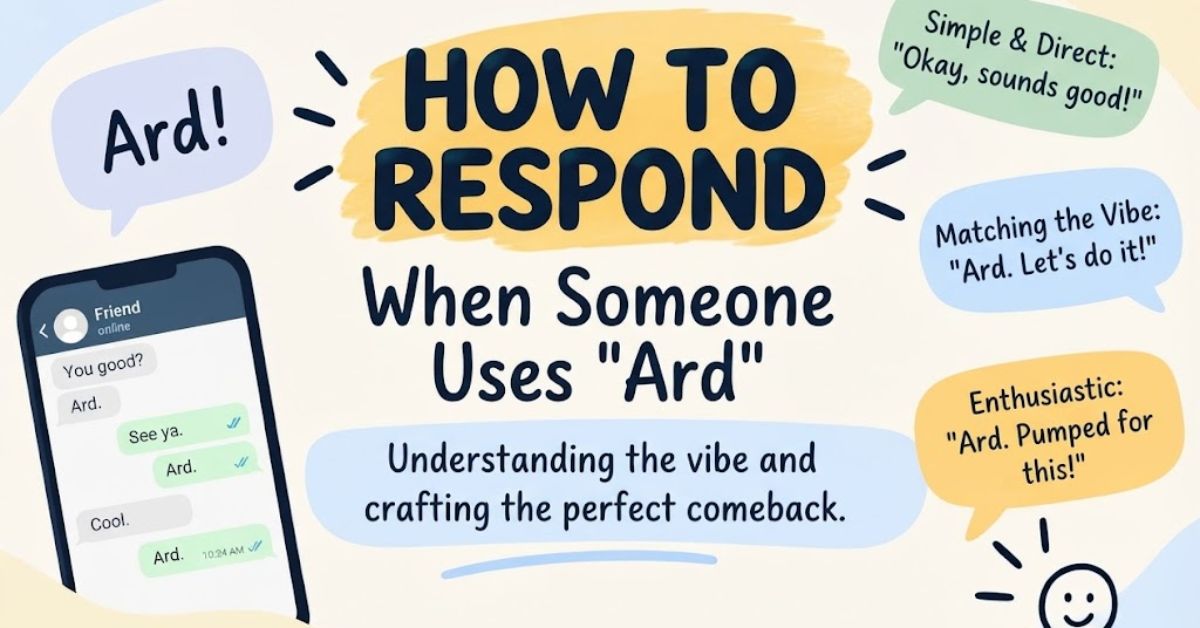
If someone sends you “ard,” you usually don’t need to overthink your reply. Start by considering what they were responding to.
Casual Replies
Use these when you’re confirming a plan or continuing an everyday conversation:
- “Cool, see you then.”
- “Sounds good!”
- “Got you.”
- “Perfect, thanks.”
- “Alright, talk soon.”
Funny Replies
If you share a playful relationship with the person, a light joke may work.
- “Straight to the point, huh? 😂”
- “Short and sweet!”
- “That’s the whole message? 😂”
Keep the joke friendly. Avoid teasing someone if they’re already upset or the conversation feels tense.
Mature / Confident Replies
For a straightforward, respectful response, try:
- “Alright, let me know if anything changes.”
- “Sounds good. I’ll see you there.”
- “Understood, thanks for confirming.”
These replies work well when you need to close a conversation without creating confusion.
Private or Respectful Replies
If someone sends “ard” after a sensitive message, consider whether they understood what you said.
For example:
You: I wanted to explain why I felt hurt yesterday.
Them: Ard.
You: I’m not sure how you feel about it. Can we talk when you’re ready?
This approach invites clarification without assuming the other person is being rude. A short text alone rarely tells the whole story.
Regional & Cultural Usage
Slang develops within communities before it sometimes spreads through music, social media, and everyday conversations. Understanding that background helps you avoid treating every informal expression as universal internet language.
Western Culture
“Ard” has a documented connection to Philadelphia youth slang. Dictionary.com discusses its regional roots and notes that the expression gained wider attention through media coverage during the 2010s.
However, that history doesn’t mean every American or English speaker uses the term regularly.
Asian Culture
People in Asian countries may encounter “ard” through online conversations, international friendships, gaming, and social media. However, there isn’t enough evidence here to claim that it has become widely established across Asian languages or cultures.
If you see it in a message, interpret it in the context of the conversation rather than assuming that everyone uses it the same way.
Middle Eastern Culture
English-language slang circulates through digital communities in the Middle East as well. Still, the presence of a slang term online doesn’t establish how common it is in a particular country or language group.
When communicating with someone unfamiliar with the expression, “okay” or “alright” is usually the safer choice.
Global Internet Usage
Social media allows regional expressions to reach people far beyond their original communities. Yet visibility isn’t the same as universal popularity.
If someone uses “ard” online, its likely meaning is “alright.” If the surrounding sentence suggests something else, ask for clarification.
FAQs
1. What does “ard” mean in texting?
“Ard” usually means “alright” or “okay.” People use it to agree, acknowledge a message, or confirm a plan in informal conversations.
2. Is “ard” rude?
No, not automatically. It usually communicates acknowledgment, but a short reply can feel dismissive depending on the conversation and relationship.
3. Is “ard” the same as “aight”?
They’re similar because both are informal forms of “alright.” Their spelling and regional usage can differ.
4. Can I use “ard” in professional messages?
It’s best to avoid it in formal emails, job applications, and client communications. Use “Understood,” “Okay,” or “Sounds good” instead.
5. Why do people use “ard” instead of “okay”?
People may prefer it because it feels casual and fits their usual way of speaking. It also provides a short way to acknowledge a message.
6. Does “ard” mean agreement?
Yes, it often signals agreement or acceptance. However, it can also acknowledge information without showing strong enthusiasm.
7. Is “ard” popular on TikTok?
You may encounter it in informal online conversations and comments. However, its overall popularity on TikTok isn’t established by the available evidence.
Conclusion
Understanding the ARD meaning is simple once you recognize its connection to “alright.” In casual texts, it usually expresses agreement, acknowledgment, or acceptance without requiring a long response.
The term also has a documented connection to Philadelphia slang, which gives it a more specific background than a random internet abbreviation.
When you see “ard” in a message, consider what came before it and how you normally communicate with that person. A simple acknowledgment can be perfectly friendly, even if it looks brief.
Use it with friends when it feels natural. In professional or sensitive conversations, choose clearer words. After all, good communication isn’t about writing the shortest possible message. It’s about making sure the other person understands what you mean.

Axel Miles is a writer and language researcher at Magazine Zeto, focused on explaining text meanings, slang, acronyms, and online expressions. Axel creates clear, practical guides that help readers understand modern digital language, with a focus on accuracy, context, and easy-to-follow explanations for everyday communication.