

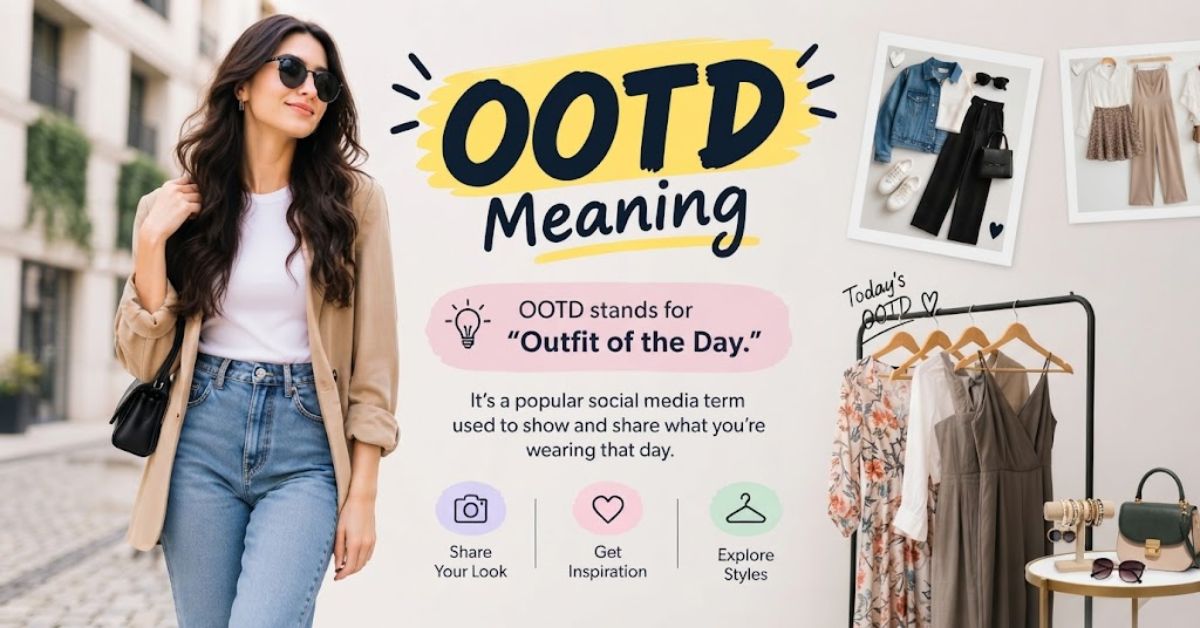
If someone texts you “OOTD” or adds #OOTD to an Instagram photo, the meaning is usually simple: OOTD stands for “Outfit of the Day.”
People use this abbreviation when they share, discuss, or ask about what someone is wearing. You may see it beside a mirror selfie, TikTok fashion video, Snapchat story, or a quick message from a friend asking for outfit advice.
Unlike some internet slang, OOTD usually doesn’t hide a second meaning. The context can make it funny, romantic, sarcastic, or playful, but the core meaning stays connected to an outfit.
OOTD Meaning in Text
OOTD means “Outfit of the Day” in text and online conversations. It refers to the clothes, shoes, accessories, or complete look someone is wearing on a particular day or occasion.
For example:
“Here’s my OOTD for dinner. What do you think?”
The person is simply showing their outfit and asking for an opinion.
You might also see:
- “Check out my OOTD.”
- “What’s your OOTD today?”
- “Sending my OOTD now.”
- “Rate my OOTD.”
- “Love your OOTD!”
- “Need help choosing my OOTD.”
The term can describe the outfit itself, a photo of that outfit, or a social media post featuring the look.
Is OOTD an Acronym?
Yes. OOTD is commonly described as an acronym or abbreviation for “Outfit of the Day.”
The four letters come from the initial letters of the phrase:
O = Outfit
O = Of
T = The
D = Day
Dictionaries classify OOTD as an informal abbreviation. In everyday speech, people often say the individual letters rather than treating it like a normal word.
So if someone writes “OOTD,” they aren’t using a secret code. They’re simply shortening a familiar fashion phrase.
What Does OOTD Mean in Chat?
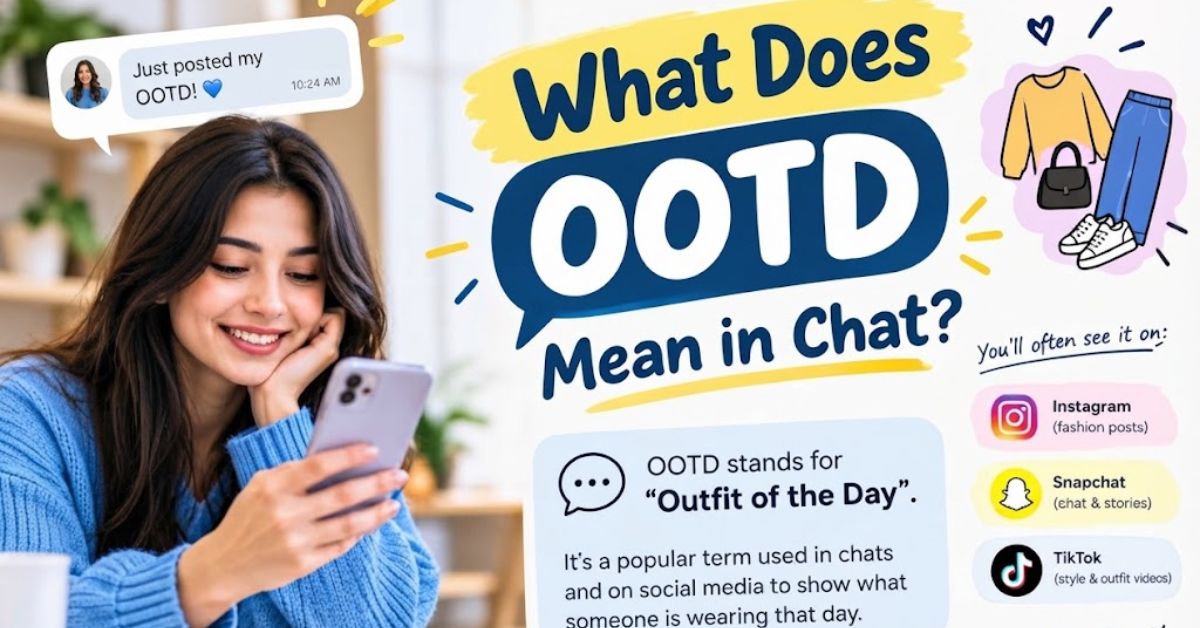
In chat, OOTD usually works as a quick label, question, or invitation to share an outfit.
For example:
Friend A: “I’m getting ready for the party.”
Friend B: “OOTD?”
Friend A: “Give me two minutes. Sending a pic.”
Here, “OOTD?” basically means, “What are you wearing?” or “Show me your outfit.”
The meaning can also change slightly depending on what surrounds it. If someone writes “Here’s my OOTD,” they’re probably showing their clothes. If they ask “Thoughts on my OOTD?” they want feedback.
Think of OOTD as a small label attached to a bigger idea. The abbreviation doesn’t explain the entire conversation. It points you toward the outfit.
OOTD Slang Meaning Across Social Media
OOTD has the same basic meaning across social platforms, but people use it differently depending on the platform.
| Platform | Common OOTD Use | Typical Context |
|---|---|---|
| Snapchat | Outfit snaps and stories | Casual and personal |
| TikTok | Outfit videos and styling content | Trendy and visual |
| Captions, photos, and hashtags | Fashion and lifestyle | |
| Private outfit sharing | Friends and family | |
| SMS | Simple outfit messages | Direct and casual |
The term has become closely connected with social media fashion culture. Cambridge specifically notes its use with photos and videos showing what someone is wearing.
OOTD Meaning on Snapchat
On Snapchat, OOTD often appears with a mirror selfie, quick snap, or private story.
Someone might send:
“OOTD before dinner 👀”
A friend could reply:
“Okay, that jacket looks good!”
Snapchat OOTD posts often feel spontaneous. They don’t need the polished look of a fashion campaign. The point is usually to share what you’re wearing right now.
OOTD Meaning on TikTok
TikTok has turned OOTD into more than a simple caption. Creators often use it in outfit transitions, styling videos, fashion hauls, and GRWM content.
For example:
“OOTD for my first day at college.”
A creator might show the outfit piece by piece before revealing the complete look.
OOTD also works well with short-form video because viewers can see the clothing, accessories, shoes, and styling choices in action.
OOTD Meaning on Instagram
Instagram is strongly associated with OOTD posts. You may see #OOTD under a mirror selfie, full-body photo, fashion post, or lifestyle image.
A caption might say:
“Sunday brunch OOTD ✨”
Creators may also mention clothing brands, accessories, locations, or styling details.
The hashtag helps identify the content as outfit-related. OOTD has long been used as a social media fashion label and discovery term.
OOTD Meaning on WhatsApp
WhatsApp usage tends to feel more private.
A friend might send a photo before a wedding and ask:
“OOTD check? Be honest.”
The recipient may then suggest different shoes, a jacket, or accessories.
Here, OOTD often serves a practical purpose. Someone wants a second opinion before leaving the house.
OOTD Meaning in SMS
OOTD can also appear in regular text messages, although people use it less often than in image-heavy social apps.
For example:
“Sending my OOTD now.”
Or:
“What’s your OOTD for tonight?”
The meaning doesn’t change just because the platform changes. The abbreviation still refers to the person’s outfit for the day.
Tone & Context Variations
OOTD itself doesn’t have separate secret meanings for different emotions. Instead, the surrounding words create the tone.
That’s an important detail because the same abbreviation can sound completely different in different conversations.
Funny Tone
People often use OOTD humorously when the outfit isn’t particularly glamorous.
“OOTD: pajamas because I gave up.”
The humor comes from the sentence around OOTD, not from the abbreviation itself.
Sarcastic Tone
Sarcastic OOTD captions often exaggerate how impressive or unimpressive an outfit is.
“OOTD: another black hoodie. Groundbreaking.”
The person isn’t seriously presenting a new fashion trend. They’re joking about wearing something ordinary.
Romantic Tone
In a romantic conversation, OOTD can become a way to invite a compliment.
“Sending you my OOTD before our date ❤️”
A partner might respond:
“You already know you’re going to look amazing.”
The abbreviation remains unchanged. The relationship creates the romantic tone.
Angry Tone
An angry or annoyed use is uncommon. More often, the person sounds frustrated with getting dressed.
“OOTD after trying on 12 outfits. I officially give up.”
Again, the frustration comes from the rest of the message.
Playful Tone
A playful OOTD message can invite interaction.
“Rate my OOTD from 1 to 10. No mercy.”
The sender may want compliments, honest feedback, or simply a fun conversation.
10+ Real Chat Examples
Here are natural examples of how people might use OOTD in everyday conversations:
- A: “OOTD check?”
B: “Absolutely. Send the pic.” - A: “Here’s my OOTD for brunch.”
B: “That color looks great on you.” - A: “What’s your OOTD for the wedding?”
B: “Blue suit with white sneakers.” - A: “Rate my OOTD.”
B: “Easy 9/10.” - A: “OOTD for college.”
B: “Simple but seriously cute.” - A: “My OOTD is basically comfort mode.”
B: “Honestly, same.” - A: “Sending my OOTD before we leave.”
B: “I need to see it first.” - A: “OOTD: all black again.”
B: “You have a brand at this point.” - A: “Do you like my OOTD?”
B: “Yes. Keep the jacket.” - A: “OOTD reveal in three seconds.”
B: “I’m waiting 👀.” - A: “Need help with my OOTD.”
B: “Send both options.” - A: “Love your OOTD!”
B: “Thank you! That made my day.”
Grammar & Language Role
OOTD works differently from a normal sentence. It’s a compact piece of social media language that people use as a label or noun-like expression.
Part of Speech
OOTD commonly functions like a noun or noun phrase.
For example:
“I love your OOTD.”
Here, OOTD refers to the person’s outfit.
It can also work as a caption label:
“OOTD for Friday night.”
Oxford Learner’s Dictionaries lists OOTD as an informal noun connected with clothes worn on a particular day or occasion.
Sentence Role
OOTD can appear in several positions.
As a standalone label:
“OOTD!”
At the beginning of a phrase:
“OOTD for brunch.”
Inside a sentence:
“Your OOTD looks amazing.”
As a question:
“What’s your OOTD?”
This flexibility makes it useful for captions and fast conversations.
Does It Replace a Full Sentence?
Not usually.
OOTD acts more like a label or shorthand than a complete sentence.
For example:
“OOTD!”
doesn’t explain exactly what the person is wearing. It signals that an outfit photo, description, or discussion is coming.
In a casual chat, that’s perfectly normal because the photo or surrounding conversation supplies the missing information.
Formal vs Informal Usage
OOTD is informal language.
It’s suitable for:
- Text messages
- DMs
- Social media captions
- Casual conversations
- Friends’ group chats
- Fashion communities
It’s less suitable for:
- Academic essays
- Formal reports
- Business proposals
- Official letters
- Professional emails
For formal writing, simply use “outfit” or “clothing worn for the day.”
How to Reply When Someone Says “OOTD”
There isn’t one perfect response. Your reply should match the relationship and the mood.
Funny Replies
Try these when you’re joking with a friend:
- “Serving looks today!”
- “Okay, fashion icon.”
- “That outfit understood the assignment.”
- “Drop the brand list.”
- “10/10. No notes.”
- “Main character energy.”
Serious Replies
If someone wants genuine fashion feedback, keep it specific:
- “That color works really well on you.”
- “The jacket pulls the whole outfit together.”
- “That looks perfect for the occasion.”
- “The shoes match the outfit nicely.”
Specific compliments feel more thoughtful than simply saying “Nice.”
Flirty Replies
If the conversation already has a romantic vibe, you could say:
- “You’re making that outfit look even better.”
- “Okay, you definitely got my attention.”
- “You look amazing.”
- “That outfit is going to turn heads.”
Keep flirty replies appropriate to the relationship. A simple compliment often works better than forcing a clever line.
Neutral Replies
When you want to stay friendly and simple:
- “Looks good!”
- “Love it.”
- “Nice outfit.”
- “Great choice.”
- “That works.”
- “Cool look.”
If someone asks for your own OOTD, simply describe what you’re wearing.
Is OOTD Rude or Bad?
No. OOTD isn’t inherently rude, offensive, or disrespectful. It’s a casual fashion abbreviation.
However, the surrounding message can still be rude. For example, criticizing someone’s appearance isn’t automatically harmless just because the conversation includes OOTD.
The abbreviation itself doesn’t carry an offensive meaning.
Can You Use It in School?
Yes, you can use OOTD in casual conversations, student group chats, social posts, or messages with friends.
For an assignment or formal school paper, use the full phrase or simply say “outfit.”
Can You Use It at Work?
You can use OOTD in a relaxed workplace chat if your team regularly uses casual language.
For formal emails, client communication, reports, and professional documents, “outfit” is the safer choice.
Who Uses This Term?
OOTD appears across different age groups, although it has strong roots in online fashion and social media culture.
Common users include:
- Gen Z social media users
- Younger Millennials
- Fashion enthusiasts
- Lifestyle creators
- Content creators
- Fashion influencers
- Everyday users sharing outfit photos
You don’t need to be a fashion influencer to use OOTD. A person posting a work outfit or asking a friend which shoes to wear can use it naturally.
Regions
OOTD is widely understood in English-language online spaces, particularly in the United States, United Kingdom, Canada, and Australia. Its use also extends across global social media communities where English internet slang is common.
Most Common Platforms
You’ll commonly encounter OOTD on:
- TikTok
- Snapchat
- YouTube
- Group chats and DMs
The exact format changes, but the basic meaning stays the same.
Origin & Internet Culture
OOTD grew through online fashion culture as people began documenting what they wore and sharing outfit inspiration.
Early fashion blogs helped popularize daily outfit posts. Social networks later made the format easier to share through photos, hashtags, and short videos. OOTD eventually became closely associated with platforms such as Instagram and later TikTok.
The term also fits perfectly with today’s visual internet. A single photo can show an entire outfit without a long explanation.
That makes OOTD useful for personal style, fashion inspiration, creator content, and even brand promotion.
Today, the idea has expanded beyond a simple mirror selfie. An OOTD can appear as a photo, styling video, outfit transition, GRWM clip, or casual message to a friend.
Comparison Table: OOTD vs Similar Slang
| Term | Meaning | Main Use | Common Context |
|---|---|---|---|
| OOTD | Outfit of the Day | Showing an outfit | Fashion and social media |
| GRWM | Get Ready With Me | Showing the getting-ready process | TikTok, Instagram, YouTube |
| FOTD | Face of the Day | Showing makeup or facial styling | Beauty content |
| MOTD | Makeup of the Day | Sharing a makeup look | Beauty and social media |
| Fit | Outfit or clothing look | Referring to an outfit | Casual slang |
| OOTN | Outfit of the Night | Showing an evening outfit | Parties and events |
OOTD and GRWM often appear together, but they aren’t identical. GRWM focuses on the process of getting ready, while OOTD focuses on the finished outfit.
Real-World Usage Insight
In real conversations, people usually don’t stop to explain OOTD. The context does most of the work.
If someone sends a mirror selfie with “OOTD,” they’re probably showing their outfit. If they text “OOTD?” before a party, they may be asking what you’re wearing.
You may also see lowercase forms such as ootd, especially in casual messages. The capitalization doesn’t change the meaning.
Likewise, #OOTD simply turns the term into a social media hashtag.
One useful rule is easy to remember:
If the conversation involves clothes, styling, or an outfit photo, OOTD almost certainly means “Outfit of the Day.”
Frequently Asked Questions About OOTD
What Does OOTD Mean in Text Messages and Online Chat?
OOTD means “Outfit of the Day.” In messages, people use it to show their outfit, ask what someone is wearing, or request style feedback.
What Does OOTD Mean on Snapchat and TikTok?
It still means “Outfit of the Day.” Snapchat tends to use it for casual outfit snaps, while TikTok often uses it with fashion videos, styling content, and GRWM posts.
Is OOTD Rude, Disrespectful, or Harmless Slang?
OOTD is harmless fashion slang. It isn’t rude or offensive by itself. The surrounding message determines whether a conversation sounds friendly, sarcastic, romantic, or critical.
How Should You Reply When Someone Says “OOTD”?
You can compliment the outfit, ask where an item came from, give honest feedback, or respond playfully. “Looks great!” works when you want to keep it simple.
Is OOTD the Same as IDK or Different?
They’re completely different. OOTD means “Outfit of the Day,” while IDK means “I don’t know.” OOTD relates to fashion and clothing.
Can You Use OOTD in School or Work?
Yes, in casual conversations or informal chats. For academic assignments, formal emails, reports, and professional documents, use clearer wording such as “outfit.”
Final Thoughts: When to Use OOTD (And When to Avoid It)
OOTD is one of those internet abbreviations that’s easy to understand once you know the four letters. It means “Outfit of the Day” and usually refers to the clothes, shoes, accessories, or complete look someone is wearing.
Use OOTD when you’re:
- Sharing an outfit photo
- Asking for fashion feedback
- Posting a social media caption
- Talking with friends
- Sharing style inspiration
- Creating fashion or lifestyle content
Avoid it in formal writing where a standard word such as “outfit” sounds clearer.
Most importantly, don’t overthink the term. OOTD doesn’t usually contain a hidden message. Whether it appears in a TikTok caption, Snapchat story, Instagram post, WhatsApp chat, or simple text message, the basic idea remains the same: someone is talking about an outfit they’re wearing that day.

Axel Miles is a writer and language researcher at Magazine Zeto, focused on explaining text meanings, slang, acronyms, and online expressions. Axel creates clear, practical guides that help readers understand modern digital language, with a focus on accuracy, context, and easy-to-follow explanations for everyday communication.