

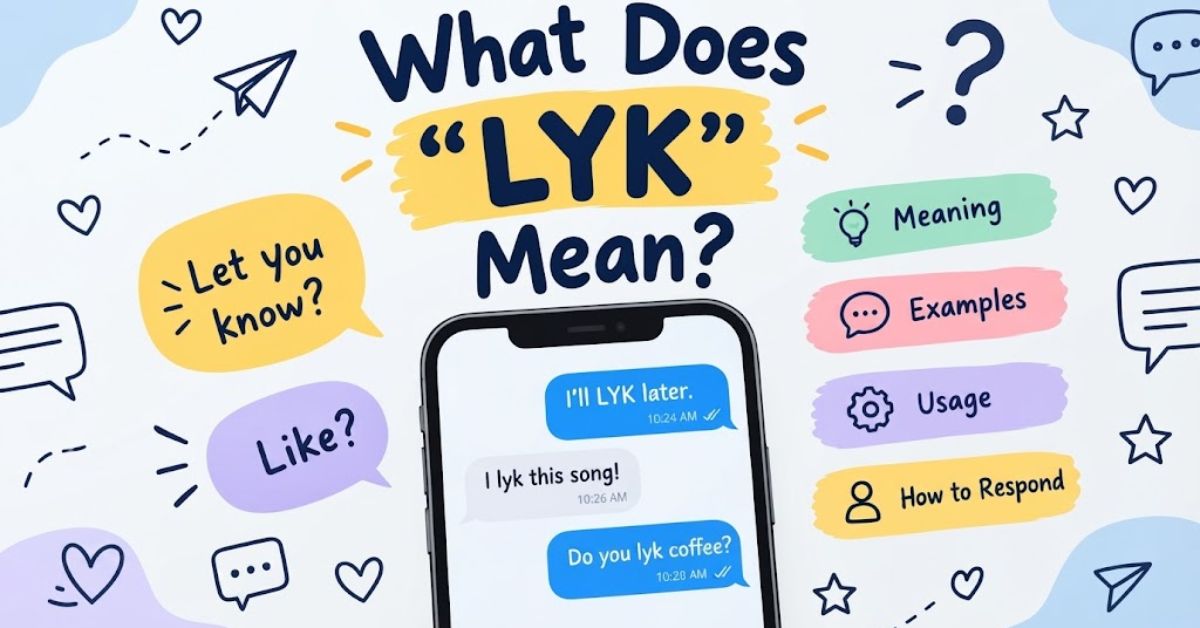
If someone texts “I’ll LYK”, you might wonder what those three letters mean. Is LYK another way to write “like,” or does it stand for something else?
The answer depends on where and how you see it.
In modern texting, LYK most commonly means “let you know.” For example, “I’ll LYK tonight” means “I’ll let you know tonight.” However, lowercase “lyk” can also appear as an informal spelling of “like,” especially in phrases such as “I lyk this song.” Current online usage shows both meanings, so the surrounding sentence matters. People may ask questions: What does LYK mean?
LYK: Quick Meaning
Simple definition:
LYK usually means “let you know” in texting and online chats.
People use it when they don’t have an answer yet but expect to provide an update later.
For example:
“I’m not sure if I can come. I’ll LYK tonight.”
This means:
“I’m not sure if I can come. I’ll let you know tonight.”
However, “lyk” can also mean “like” when someone uses it as a shortened spelling rather than an acronym.
Compare:
| Message | Meaning |
|---|---|
| “I’ll LYK tomorrow.” | I’ll let you know tomorrow. |
| “I’ll lyk when I get home.” | I’ll let you know when I get home. |
| “I lyk this song.” | I like this song. |
| “It looks lyk rain.” | It looks like rain. |
So, don’t judge LYK by the letters alone. Read the whole sentence.
Example uses:
Here are some common examples:
- “I’ll LYK later.” = I’ll let you know later.
- “I’ll LYK when I get there.” = I’ll let you know when I arrive.
- “LYK if anything changes.” = Let you know if anything changes.
- “I lyk your new profile pic.” = I like your new profile picture.
- “That looks lyk fun.” = That looks like fun.
The first three examples use LYK as an abbreviation for “let you know.” The last two use lyk as a casual spelling of “like.”
Origin & Background
Where it comes from:
LYK belongs to the wider world of texting abbreviations and internet shorthand. People often shorten familiar phrases because typing a few characters feels quicker in a fast conversation.
The phrase “let you know” naturally becomes LYK because each letter represents the beginning of a word:
L = Let
Y = You
K = Know
That makes it similar to other texting abbreviations such as LMK, BTW, and IDK.
The other use, “lyk” for “like,” works differently. It isn’t normally an acronym. Instead, it represents an informal shortened spelling.
Why it stuck:
Short forms work well in digital conversations because they save space and keep replies moving.
For example, compare:
“I don’t know yet. I’ll let you know when I get home.”
with:
“Not sure yet. I’ll LYK when I get home.”
The second message feels quicker and more natural in an informal chat.
Still, texting shorthand doesn’t belong everywhere. A casual DM and a job application don’t need the same language.
Real-Life Conversations
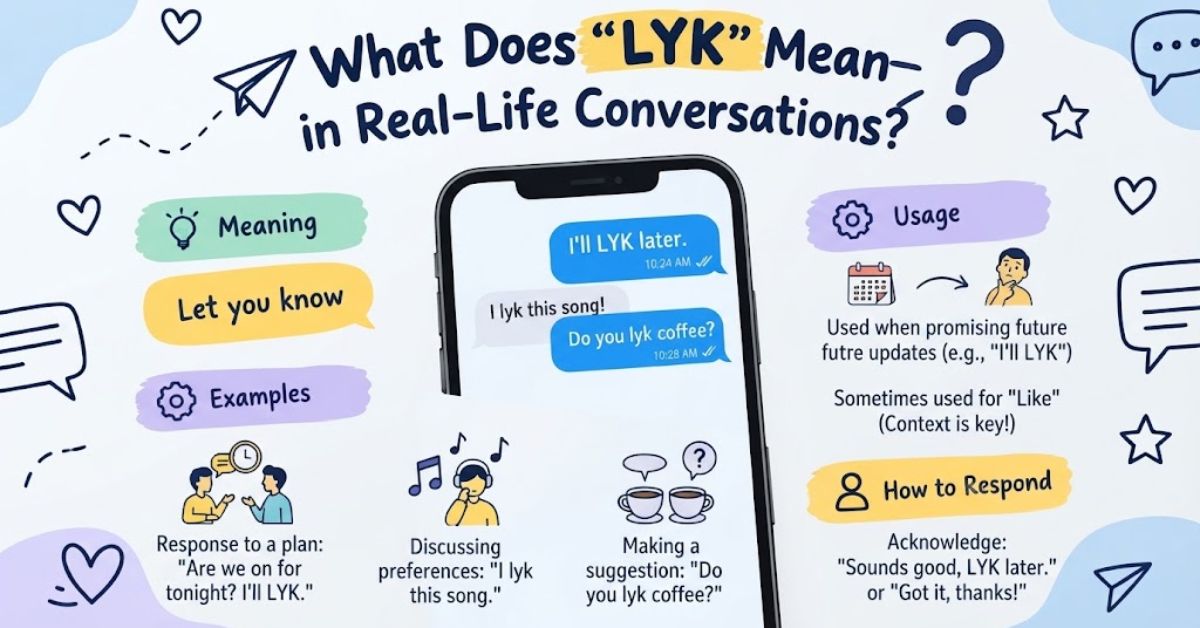
1. WhatsApp Chat
Friend A: Are you coming to dinner tonight?
Friend B: Not sure yet. I’ll LYK after work.
Here, LYK clearly means “let you know.”
Now consider another example:
Friend A: Do you lyk this restaurant?
Friend B: Yeah, the food looks amazing.
Here, lyk means “like.”
The sentence gives you the answer.
2. Instagram DM
Person A: Did the store reply about the shoes?
Person B: Nope. I’ll LYK when they respond.
Meaning: I’ll let you know when they respond.
In another conversation:
Person A: I lyk your new outfit!
Person B: Thanks! That’s so nice of you.
Here, lyk means “like.”
3. Text Message
Person A: Do you know what time the movie starts?
Person B: I’m checking. I’ll LYK in a minute.
The sender hasn’t found the information yet. They’re promising to provide an update.
4. TikTok Comments
User A: Where did you get that jacket?
Creator: I’ll LYK when I find the link!
Here, LYK means “let you know.”
The same three letters can have another meaning in a casual comment:
“I lyk this trend.”
That means “I like this trend.”
This is why context beats guesswork.
Read More: What Does BMF Meaning in Text? (2026 Slang Guide with Examples & Replies)
Emotional & Psychological Meaning
What it reflects:
LYK itself doesn’t carry a special psychological meaning. In most cases, it simply shows informal digital communication.
Depending on the sentence, it can sound:
- Casual
- Friendly
- Quick
- Practical
- Relaxed
- Slightly playful
For example, “I’ll LYK” often signals that the person hasn’t made a decision yet. It doesn’t automatically mean they’re avoiding you or acting uninterested.
Subtle emotional difference:
Compare these messages:
“I’ll let you know when I find out.”
This sounds complete and neutral.
“I’ll LYK when I find out.”
This feels shorter and more casual.
The meaning stays almost identical. The main difference comes from style and context, not from a hidden emotion.
Likewise:
“I like this.”
sounds standard.
“I lyk this.”
looks more informal and stylized.
Don’t read too much into the spelling alone. The surrounding conversation matters far more.
Usage in Different Contexts

1. Social Media
You may encounter LYK in:
- Comments
- DMs
- Replies
- Captions
- Group chats
For example:
“I’ll LYK once I confirm the date.”
On social media, people often use short forms because conversations move quickly.
2. Friends & Relationships
LYK works naturally between friends, partners, classmates, and other people who already communicate casually.
Examples include:
“I’ll LYK when I’m free.”
“I’ll lyk after class.”
“I lyk your new haircut.”
The relationship doesn’t change the basic meaning. The sentence determines the meaning.
3. Work or Professional Settings
It’s usually better to avoid LYK in formal workplace writing.
Instead of:
“I’ll LYK tomorrow.”
write:
“I’ll let you know tomorrow.”
The full phrase looks clearer and more polished in emails, reports, applications, and formal business communication.
Some casual workplace chats may tolerate texting abbreviations. However, when professionalism matters, spelling out the phrase remains the safer choice.
4. Casual vs. Serious Tone
| Situation | LYK appropriate? | Better choice |
|---|---|---|
| Texting a close friend | Yes | LYK |
| Instagram DM | Yes | LYK |
| Casual group chat | Yes | LYK |
| Comment on social media | Usually | LYK |
| Professional email | No | Let you know |
| Job application | No | Let you know |
| Academic assignment | No | Like / let you know |
| Formal complaint | No | Full wording |
The rule is simple: use LYK when the conversation is informal and clarity won’t suffer.
Common Misunderstandings
1. Thinking it means something different
The biggest mistake is assuming LYK always has one definition.
In current texting usage, “let you know” is the most common interpretation, especially in phrases such as “I’ll LYK.” However, lyk can also represent “like” in informal writing.
Look at the sentence before deciding.
2. Confusing it with tone
LYK doesn’t automatically mean sarcasm, flirting, anger, or disinterest.
For example:
“I’ll LYK tonight.”
is usually just a promise to provide an update.
The emotional meaning comes from the rest of the conversation.
3. Overusing it
Texting shorthand can become distracting when every sentence contains an abbreviation.
For example:
“I’ll lyk if u lyk it bc idk if u want it.”
This may be understandable, but it looks crowded.
Clear writing still wins, even in casual chats.
4. Using it in serious situations
Avoid LYK when the message needs maximum clarity.
For example, a customer service response should say:
“We’ll let you know once your request has been reviewed.”
That sounds more professional than:
“We’ll LYK once we check.”
Comparison Table
| Term | Meaning | Tone | Common use |
|---|---|---|---|
| LYK | Let you know | Casual | Texts and chats |
| lyk | Like | Informal | Casual posts and messages |
| LMK | Let me know | Casual | Asking someone for information |
| IDK | I don’t know | Casual | Texting |
| BTW | By the way | Casual | Chats and DMs |
| TBH | To be honest | Casual | Social media and messages |
| Like | Like | Neutral | Everyday and formal writing |
Key Insight:
LYK doesn’t always have one fixed meaning.
If you see “I’ll LYK,” it almost certainly means “I’ll let you know.”
If you see “I lyk it,” the writer may simply mean “I like it.”
That distinction is the key to understanding the abbreviation.
Variations / Types of “LYK”
Here are some common patterns you’ll see online:
“I’ll LYK”
Means:
I’ll let you know.
Example:
“I’ll LYK after I talk to my parents.”
“LYK when…”
Means the person wants someone to provide information.
Example:
“LYK when you arrive.”
In this sentence, the intended meaning is closer to “let me know when you arrive.” Because abbreviations can become ambiguous, the full sentence provides important context.
“I lyk it”
Means:
I like it.
Example:
“I lyk this new song.”
“Do you lyk…?”
Means:
Do you like…?
Example:
“Do you lyk this color?”
“Looks lyk…”
Means:
Looks like…
Example:
“It looks lyk rain.”
These informal spellings appear less consistently than the “let you know” abbreviation. That’s another reason context matters.
Read More: ATP Meaning Slang: What It Really Means in Texts, Social Media, and Everyday Conversations
How to Respond When Someone Uses “LYK”
1. Casual Replies
If someone says:
“I’ll LYK tonight.”
You can simply answer:
- “Okay!”
- “Sounds good.”
- “Sure, let me know.”
- “No problem.”
- “Alright, thanks.”
You don’t need to use LYK just because the other person did.
2. Funny Replies
For a playful conversation, you could say:
- “Cool, I’ll wait for the official update 😂”
- “Alright, keep me posted!”
- “Deal. I’ll be waiting 👀”
Keep the humor appropriate to your relationship.
3. Mature / Confident Replies
If you want to sound calm and direct:
- “Sure, just let me know.”
- “No rush. Let me know when you decide.”
- “Sounds good. I’ll wait for your update.”
These responses work well when the conversation involves plans or a decision.
4. Respectful / Private Replies
If the topic feels personal, don’t pressure the other person.
Try:
- “Take your time.”
- “No worries. Let me know when you’re comfortable.”
- “That’s okay. Just update me when you can.”
A short abbreviation doesn’t require a complicated response.
Regional & Cultural Usage
Western Culture
LYK appears in English-language texting and social media conversations. However, usage varies by person, age, platform, and communication style.
It’s best understood as informal digital shorthand, not as a formal English expression.
Asian Culture
English texting abbreviations can also appear in online conversations among people who communicate partly in English.
However, usage isn’t identical across every country or language community. A person’s preferred online style matters more than a broad regional label.
Middle Eastern Culture
English abbreviations such as LYK may appear in bilingual or English-language chats.
Again, context matters. A mixed-language conversation may combine English shorthand with Arabic or another language, so the surrounding words can help clarify the intended meaning.
Global Internet Usage
Because English dominates much of online communication, texting abbreviations can travel across borders quickly.
Still, LYK isn’t universally interpreted the same way. If the sentence looks unclear, read the complete message before deciding what the abbreviation means.
Read More: Dreamt or Dreamed: Which One Is Correct? Meaning, Usage, and Real-Life Examples
FAQs
1. What does “lyk” mean in texting?
LYK most commonly means “let you know.” In some informal writing, lowercase “lyk” can also mean “like.”
2. Is “lyk” a typo or intentional?
Usually, LYK is intentional texting shorthand, although “lyk” can also be a casual spelling of “like.”
3. Is “lyk” rude?
No. LYK isn’t inherently rude. Its tone depends on the sentence and the relationship between the people chatting.
4. Should I use “lyk” in professional messages?
It’s better to avoid it in formal emails, applications, reports, and official communication. Write “let you know” or “like” instead.
5. Why do people use “lyk” instead of “like”?
People may use “lyk” as a casual shortened spelling of “like” because it feels quick and informal.
6. Is “lyk” common?
LYK is used in casual digital communication, although its meaning and frequency vary by platform and person. Current search results commonly identify “let you know” as its primary texting meaning.
7. Can “lyk” mean something else?
Yes. Context can make LYK mean “let you know” or “like.” For example, “I’ll LYK later” means “I’ll let you know later,” while “I lyk it” can mean “I like it.”
Conclusion
So, what does LYK mean?
The safest answer is “let you know” when you see it in a phrase such as “I’ll LYK.” That meaning dominates current texting and chat usage.
However, context can change the picture. In informal online writing, “lyk” can also stand in for “like,” as in “I lyk this song.”
The easiest way to decode it is to look at the whole sentence. If someone promises an update, think “let you know.” If the word expresses preference or comparison, think “like.”
Once you spot that difference, LYK becomes much less mysterious.

Axel Miles is a writer and language researcher at Magazine Zeto, focused on explaining text meanings, slang, acronyms, and online expressions. Axel creates clear, practical guides that help readers understand modern digital language, with a focus on accuracy, context, and easy-to-follow explanations for everyday communication.