


Dreamt or dreamed can make even confident English speakers stop for a second. You may have seen both forms in books, conversations, and online posts and wondered whether one is wrong.
The good news is simple: both “dreamt” and “dreamed” are correct past tense and past participle forms of the verb “dream.” The main difference comes from regional preference, frequency, and writing style rather than meaning.
For example, you can write:
I dreamed about my childhood home last night.
Or:
I dreamt about my childhood home last night.
Both sentences are grammatically correct. The choice usually depends on the variety of English you use and the style you prefer.
Dreamt or Dreamed: Quick Meaning
Dreamed and dreamt both describe something you experienced in a dream or imagined while awake. They work as the simple past and past participle forms of dream.
The verb dream has two main meanings:
- To experience thoughts, images, or feelings while sleeping.
- To imagine, hope for, or strongly desire something.
So, both forms work in sentences about sleep and personal ambitions.
For instance:
I dreamed about flying over the ocean.
She dreamt of becoming a doctor.
They dreamed of building their own business.
He dreamt that he was back at school.
The meaning doesn’t change when you replace dreamed with dreamt.
Simple Examples:
Here are a few everyday examples:
- I dreamed about you last night.
- I dreamt about you last night.
- She dreamed of becoming a writer.
- She dreamt of becoming a writer.
- We dreamed about traveling the world.
- We dreamt about traveling the world.
- He had dreamed of this moment for years.
- He had dreamt of this moment for years.
Notice the pattern. Both forms fit naturally into the same sentences.
Origin & Background
The difference between dreamed and dreamt comes from the way English has developed different verb forms over time.
Dreamed follows the regular past tense pattern. English commonly forms the past tense by adding -ed to a verb.
For example:
dream → dreamed
Dreamt follows a shorter irregular pattern:
dream → dreamt
English contains several verbs with both regular and irregular past forms. Similar pairs include learned and learnt, burned and burnt, and spelled and spelt in varieties where those forms are used.
Cambridge Dictionary lists dreamt as both the past simple and past participle of dream. It also identifies dreamed as the US form in its dictionary entry.
Evolution Over Time:
English doesn’t always follow one neat formula. Over centuries, speakers have developed and retained different verb forms across regions.
In modern English, dreamed and dreamt both remain established forms. British English uses both, while American English strongly favors dreamed. Importantly, this doesn’t mean British speakers only use dreamt or that American speakers cannot understand or encounter it.
That regional difference explains much of the confusion.
If you read British literature, you may encounter dreamt frequently. If you write for a primarily American audience, dreamed will usually sound more familiar.
Real-Life Conversations

Grammar becomes much easier when you see it in ordinary conversation. Both forms can sound completely natural depending on the speaker and context.
WhatsApp Chat
Person A: I had the strangest dream last night.
Person B: Really? What happened?
Person A: I dreamed I was flying over the city.
Person B: That sounds amazing!
You could also write:
Person A: I dreamt I was flying over the city.
The meaning stays the same.
Instagram DMs
Person A: I finally started working toward my goals.
Person B: That’s amazing. You always dreamed of doing this.
Here, dreamed of refers to a long-term hope or ambition rather than something that happened during sleep.
Text Message
Person A: I dreamed about my old school last night.
Person B: Maybe you were feeling nostalgic.
Again, dreamed could become dreamt without changing the meaning.
This flexibility makes the choice mostly a matter of English variety and personal style.
Read More : GNG Meaning in Chat: What It Really Means in Text, Slang, and Social Media
Emotional & Psychological Meaning
The word dream has a powerful connection with emotions. Sometimes it describes a nighttime experience. At other times, it represents a goal you’ve carried for years.
Consider this sentence:
I always dreamed of opening my own business.
Here, dreamed doesn’t describe sleep. It describes ambition.
Now compare it with:
I dreamed about my old friend last night.
This sentence describes an experience during sleep.
The surrounding words tell you which meaning applies.
Why People Connect With It:
Dreams often appear in conversations about:
- hopes and ambitions
- childhood memories
- personal goals
- relationships
- fears
- imagination
- future plans
- nighttime experiences
That’s why phrases such as “I always dreamed of this” can feel emotional. The speaker isn’t simply describing an idea. They’re often talking about something they’ve wanted for a long time.
Likewise, “I dreamt about you” can sound personal because it connects another person with a private nighttime experience.
Usage in Different Contexts
The best choice depends partly on your audience. Think of dreamed and dreamt as two roads leading to the same destination.
Social Media
On social media, either form can work.
For a broad American audience, dreamed may feel more familiar:
I always dreamed of traveling the world.
A British English speaker might naturally write:
I always dreamt of traveling the world.
Neither sentence changes the underlying meaning.
Friends & Relationships
In casual conversations, both forms work naturally.
I dreamed about you last night.
I dreamt about you last night.
The second version can sometimes sound more literary or traditional to an American reader. However, that is a style impression rather than a grammar rule.
Work or Professional Settings
For professional writing, dreamed can be a straightforward choice, particularly when writing for an American audience.
For example:
The founder dreamed of creating a company that served small businesses.
However, dreamt isn’t grammatically wrong in professional writing. If your publication uses British English, you may see it regularly.
The key is to follow the English variety and editorial style of your audience.
Casual vs Serious Tone
Neither word automatically creates a casual or serious tone.
Still, dreamt may sometimes feel more literary or traditional, especially to American readers. Dreamed often feels more familiar and neutral in modern American English.
Context matters more than the verb itself.
Common Misunderstandings
A few myths make this simple grammar question seem harder than it really is.
“One is correct and the other is wrong”
False. Both dreamed and dreamt are correct forms of dream. Major English references recognize both forms.
“Dreamt is outdated”
Not necessarily.
People still use dreamt, particularly in British English and other varieties influenced by British usage. It also appears in contemporary writing and speech.
“They have different meanings”
They don’t have different basic meanings.
Both forms can describe dreaming during sleep or imagining something while awake.
For example:
She dreamed of becoming a musician.
She dreamt of becoming a musician.
The meaning remains the same.
When NOT to Use:
There’s one especially useful grammar rule to remember.
After did, use the base form dream, not dreamed or dreamt.
Correct:
Did you dream about me?
Incorrect:
Did you dreamed about me?
Incorrect:
Did you dreamt about me?
Why? Did already carries the past tense, so the main verb returns to its base form.
This rule also appears with other verbs:
Did you go?
Not:
Did you went?
This small distinction can make your English sound much more polished.
Dreamt or Dreamed: Comparison Table
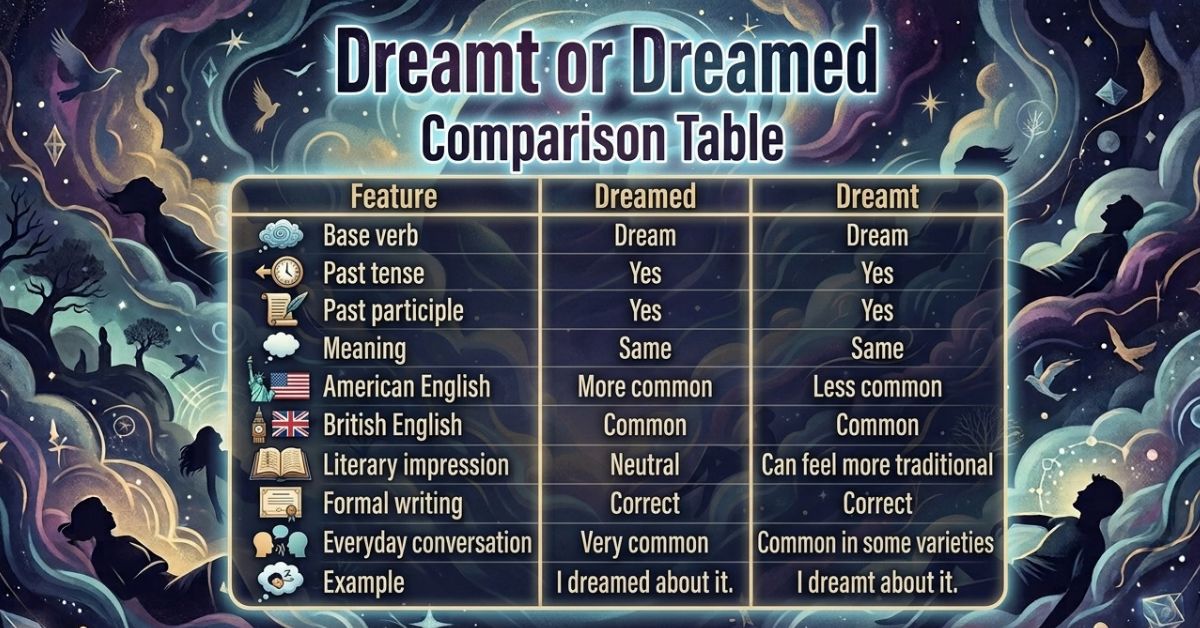
| Feature | Dreamed | Dreamt |
|---|---|---|
| Base verb | Dream | Dream |
| Past tense | Yes | Yes |
| Past participle | Yes | Yes |
| Meaning | Same | Same |
| American English | More common | Less common |
| British English | Common | Common |
| Literary impression | Neutral | Can feel more traditional |
| Formal writing | Correct | Correct |
| Everyday conversation | Very common | Common in some varieties |
| Example | I dreamed about it. | I dreamt about it. |
Current grammar references agree that both forms can function as the past tense and past participle of dream. Usage frequency varies by English variety.
Key Insight:
Use dreamed when you want the familiar default for American English. Use dreamt when it fits your preferred variety or style.
You don’t need to treat one form as grammatically superior.
Read More : IDTS Meaning: What “IDTS” Really Means in Texts, Social Media, and Everyday Conversations
Variations / Types
The verb dream appears in several useful expressions.
Dreamed or Dreamt About
Use dream about when talking about the content or subject of a dream.
I dreamed about my childhood home.
I dreamt about my childhood home.
Dreamed or Dreamt Of
Use dream of when discussing a goal, hope, or desired possibility.
She dreamed of becoming a doctor.
She dreamt of becoming a doctor.
Always Dreamed or Always Dreamt
This phrase often describes a long-held ambition.
I’ve always dreamed of visiting New York.
I’ve always dreamt of visiting New York.
Never Dreamed or Never Dreamt
This expression can describe something unexpected.
I never dreamed this would happen.
I never dreamt this would happen.
Dreamed Big
Dreamed big means someone imagined or pursued something ambitious.
She dreamed big and built her career from scratch.
Dreaming
Dreaming is the present participle of dream.
I’m dreaming about my vacation.
Dreams
Dreams can function as a noun or the third-person singular present form.
My dreams are vivid.
She dreams of becoming a writer.
These variations help you understand how the word works beyond the simple dreamed vs. dreamt question.
How to Respond When Someone Uses It
When someone says they dreamed or dreamt about something, your response depends on the situation.
Casual Replies
For a normal conversation, you can say:
- “Really? What happened?”
- “That sounds interesting!”
- “What was the dream about?”
- “Dreams can be so random.”
Funny Replies
If you’re joking with a friend:
- “Your brain really created a whole movie!”
- “At least your dream had a better plot than most shows.”
- “Your brain needs a vacation too!”
Mature / Confident Replies
For a more thoughtful response:
- “That sounds like it meant something to you.”
- “Interesting. Sometimes dreams bring old memories back.”
- “That must have been quite an experience.”
Private / Respectful Replies
If someone shares something personal:
- “Thanks for sharing that with me.”
- “That sounds personal. Are you okay?”
- “I understand. Some dreams can feel surprisingly real.”
The exact response matters more than whether the person said dreamed or dreamt.
Regional & Cultural Usage
English changes slightly from one region to another. That’s normal.
Western Culture
In American English, dreamed is the usual choice. British English uses both dreamed and dreamt.
Therefore, an American reader may find dreamed more familiar, while a British reader may encounter either form comfortably.
Asian Culture
English learners across Asia may encounter both forms through textbooks, films, websites, and international communication.
Because many educational resources use different English standards, both forms may appear in learning materials. The safest approach is to follow the variety of English expected in your school, workplace, or publication.
Middle Eastern Culture
English users in the Middle East may also encounter both spellings through international media and education.
Rather than treating one as universally correct, check the English style expected by the institution or audience.
Global Internet Usage
The internet brings American, British, Australian, Canadian, and other English varieties together.
As a result, you may see dreamed and dreamt on the same website, social platform, or discussion forum. Both remain recognizable English forms.
For broad online content, dreamed is a practical default for US English. However, dreamt remains correct and useful when it matches the writer’s regional or stylistic preference.
FAQs
1. Is “dreamt” grammatically correct?
Yes. Dreamt is a grammatically correct past tense and past participle form of dream.
2. Which is better: dreamt or dreamed?
Neither is universally better. Dreamed is the usual choice in American English, while both forms are used in British English.
3. Do dreamt and dreamed have different meanings?
No. Both forms can describe dreaming during sleep or imagining and hoping for something.
4. Is dreamt more formal?
Not necessarily. It can sound more literary or traditional to some readers, but it isn’t simply a more formal version of dreamed.
5. Should I use dreamed in exams?
Follow the English variety and style expected by your school or exam. Dreamed and dreamt are both established forms, so context matters.
6. Why do Americans say dreamed more?
American English generally favors the regular -ed form, so dreamed is much more familiar in US usage.
7. Can I use both in the same article?
Yes, but consistent style usually makes an article easier to read. Choose the form that fits your target variety unless a quotation or specific context calls for another form.
Read More : FYM Meaning: What It Really Means in Text, Slang, and Social Media
Conclusion
So, dreamt or dreamed: which one is correct? The answer is simple: both are correct.
Both words serve as the past tense and past participle forms of dream. They can describe nighttime dreams as well as hopes, ambitions, and imagined possibilities.
For American English, dreamed is generally the more familiar choice. In British English, both dreamed and dreamt are used.
The easiest rule is this: choose the form that fits your audience and keep your writing consistent. And remember one useful grammar point: after did, use the base verb dream.
Once you know that, the confusion disappears. You can write “I dreamed about it,” “I dreamt about it,” or “Did you dream about it?” with confidence.

Axel Miles is a writer and language researcher at Magazine Zeto, focused on explaining text meanings, slang, acronyms, and online expressions. Axel creates clear, practical guides that help readers understand modern digital language, with a focus on accuracy, context, and easy-to-follow explanations for everyday communication.