


You’re scrolling through a text when three letters suddenly appear: “YFM.” You pause. Is it slang? A question? Or something you’re somehow supposed to know already? If you’ve seen YFM on TikTok, Instagram, Snapchat, WhatsApp, or in a group chat, the meaning can seem unclear at first.
In everyday texting, a people think What does YFM means “You Feel Me?” It’s a casual way to ask whether someone understands, agrees with, or relates to what you just said. Think of it as a quick digital check-in. The exact feeling can change with the conversation. Sometimes it sounds friendly. In other cases, it can sound serious, emotional, or slightly challenging.
YFM Meaning in Text: Quick Meaning
YFM usually means “You Feel Me?” in texting and online conversations.
In simple English, it can mean:
- Do you understand me?
- Do you get what I mean?
- Can you relate?
- Do you agree?
- Are you with me on this?
The letters come from the first letters of You Feel Me. Linguistically, YFM is more precisely an initialism because people form it from the initial letters of the phrase.
When someone adds “YFM?” after a statement, they usually want some kind of acknowledgment. They aren’t asking whether you can physically feel them. Instead, “feel” refers to understanding or connecting with their thoughts, feelings, or point of view.
The phrase works much like a spoken head nod. Someone makes a point, then asks, “You feel me?” They want to know whether you’re following along.
Quick Examples
Here are a few natural examples:
“I need a quiet weekend away from everyone, YFM?”
Meaning: “Do you understand how I feel?”
“That exam was way harder than I expected, yfm?”
Meaning: “Do you agree or relate?”
“People remember your mistakes but forget your effort. YFM?”
Meaning: “Do you understand what I’m trying to say?”
Context matters. The same three letters can feel different depending on the message before them.
Origin and Background
YFM comes from the spoken expression “You feel me?” The phrase existed in casual speech before people started shortening it for digital communication.
In conversation, “You feel me?” works as a way to check understanding or shared perspective. Over time, texting culture turned many common phrases into shorter forms. YFM fits naturally into that pattern.
Social media helped these short expressions spread quickly. People use abbreviated language because online conversations move fast. A few letters can replace an entire phrase without slowing the conversation down.
You may see YFM in:
- Text messages
- Instagram DMs
- TikTok comments
- Snapchat chats
- Discord conversations
- Group chats
- Gaming communities
- Social media captions
YFM can appear as YFM, yfm, or yfm? The capitalization usually doesn’t change the meaning.
It is also worth remembering that YFM isn’t limited to one exact emotional purpose. Depending on the sentence, it may seek agreement, understanding, empathy, or simple confirmation.
Real-Life Conversations

Seeing YFM inside a real conversation makes its meaning much easier to understand. In most cases, the sender places it after an opinion, feeling, complaint, or personal thought.
WhatsApp Conversation
Person A:
“I’m trying to stop checking my phone every five minutes.”
Person B:
“Honestly, same. It gets exhausting.”
Person A:
“Exactly. I just want some peace, YFM?”
Person B:
“Yeah, I totally get you.”
Here, YFM asks for understanding and shared experience.
Instagram DM
Person A:
“Weekend plans are better when you don’t plan anything.”
Person B:
“Honestly, that’s true.”
Person A:
“YFM!”
The expression works almost like “Right?” or “Exactly.”
Text Message
Person A:
“Sometimes you can care about someone and still need space.”
Person B:
“That makes sense.”
Person A:
“YFM?”
Person B:
“Yeah, I know what you mean.”
In this example, YFM has a more emotional tone. The sender wants the other person to understand the feeling behind the statement.
Emotional and Psychological Meaning
YFM meaning in text can do more than check whether someone understood a sentence. It can create a sense of connection.
When people use it after sharing something personal, they may be looking for validation. They want someone to recognize their experience instead of simply reading their words.
For example:
“Nobody understands how stressful this week has been, YFM?”
The sender isn’t looking for a dictionary-style answer. They may want empathy.
YFM can therefore suggest:
- Emotional understanding
- Shared experience
- Agreement
- Empathy
- Validation
- Friendship
- Connection
- Trust
However, don’t assume every YFM message has deep emotional meaning. Sometimes it is simply a casual way to say, “You know what I mean?”
The surrounding words tell you much more than the abbreviation alone.
Usage in Different Contexts
YFM meaning in text is flexible. Its meaning stays close to “You Feel Me?” but its tone can shift depending on where and how someone uses it.
Social Media
On social media, YFM meaning in text often appears after an opinion, relatable statement, or personal observation.
For example:
“Protecting your peace is more important than pleasing everyone, YFM?”
A creator may use it to invite people into the discussion. It can encourage readers to agree, comment, or share a similar experience.
You’ll often see it in:
- TikTok comments
- Instagram captions
- Snapchat messages
- Facebook posts
- Discord chats
- Group conversations
Friends and Relationships
Among friends, YFM meaning in text usually sounds relaxed and familiar.
For example:
“We don’t need expensive plans. A good meal and a movie are enough, YFM?”
Here, the sender isn’t demanding agreement. They’re simply checking whether the other person shares the same idea.
In relationships, YFM can also appear during emotional conversations. A person may use it to ask whether their partner understands how they feel.
Work or Professional Settings
YFM meaning in text generally doesn’t belong in formal workplace communication.
Avoid it in:
- Job applications
- Business emails
- Client messages
- Academic assignments
- Official reports
- Professional proposals
Instead, choose clearer phrases such as:
- “Does that make sense?”
- “Do you agree?”
- “Are we on the same page?”
- “Let me know your thoughts.”
- “I hope that explains my point.”
Professional writing values clarity. Slang can create unnecessary confusion.
Casual vs. Serious Tone
The tone of YFM meaning in text depends heavily on context.
Casual tone:
“That restaurant was seriously overrated, YFM?”
This sounds light and conversational.
Serious tone:
“Sometimes you have to walk away from people who keep hurting you, YFM?”
This carries more emotional weight.
A short “YFM?” can even sound challenging if the previous statement is argumentative. That’s why the surrounding conversation matters.
Read More : What Does YFM Meaning in Text: What It Really Means, How to Use It, and Real-Life Examples
Common Misunderstandings
YFM meaning in text looks simple, but people can misread it when they focus only on the letters.
Mistake 1: Thinking It Always Means Agreement
YFM doesn’t always mean “Do you agree?”
It can also mean “Do you understand?” or “Can you relate?” The exact meaning depends on the statement before it.
Mistake 2: Using It in Formal Emails
YFM is informal slang. It can look unprofessional in a business email, job application, academic paper, or official message.
Use a complete phrase instead when the situation requires a professional tone.
Mistake 3: Assuming Everyone Knows It
Not everyone recognizes internet slang. Someone unfamiliar with YFM may misunderstand the message or ignore the abbreviation completely.
If clarity matters, write the full phrase instead.
Comparison Table
| Expression | Meaning | Typical Tone | Best Use |
|---|---|---|---|
| YFM | You Feel Me? | Casual | Texts and chats |
| YKWM | You Know What I Mean? | Casual | Everyday conversation |
| You Get Me? | Do you understand me? | Casual | Friends and personal chats |
| KWIS | Know What I’m Saying? | Informal | Spoken-style texting |
| Right? | Do you agree? | Neutral to casual | Everyday conversation |
| Makes Sense? | Do you understand? | Neutral | Casual or semi-formal |
| FR | For Real | Casual | Agreement or emphasis |
| Facts | Strong agreement | Casual | Social media and chats |
| IYKYK | If You Know, You Know | Informal | Shared references |
YFM stands out because it can combine understanding, agreement, and emotional connection in one short phrase.
Variations and Related Expressions
1. You Feel Me?
This is the complete form of YFM. It asks whether someone understands, relates to, or agrees with a point.
2. Feel Me?
This shorter version sounds even more casual. It carries nearly the same idea as “You Feel Me?”
3. You Know What I Mean? (YKWM)
YKWM checks whether someone understands the point behind a statement. It is a close alternative to YFM.
4. You Get Me?
“You Get Me?” asks whether another person understands your thoughts or feelings. It often sounds personal and conversational.
5. Know What I’m Saying? (KWIS)
KWIS is an informal way to check whether someone follows the point being made. It has a strong spoken-conversation feel.
6. Right?
“Right?” is a simple way to seek agreement. It can replace YFM in many casual situations.
7. Makes Sense?
“Makes sense?” usually asks whether something is understandable. It focuses more on clarity than emotional connection.
8. IYKYK
IYKYK means “If You Know, You Know.” People use it for shared experiences, inside jokes, or references that certain people will understand.
9. Facts
“Facts” expresses strong agreement with a statement. Unlike YFM, it usually responds to an opinion rather than asking a question.
10. For Real (FR)
FR means “For Real.” People use it to show agreement, seriousness, or emphasis.
Read More : ND Meaning in Text: What It Really Means in Chats, Social Media & Everyday Conversations
How to Respond When Someone Uses YFM
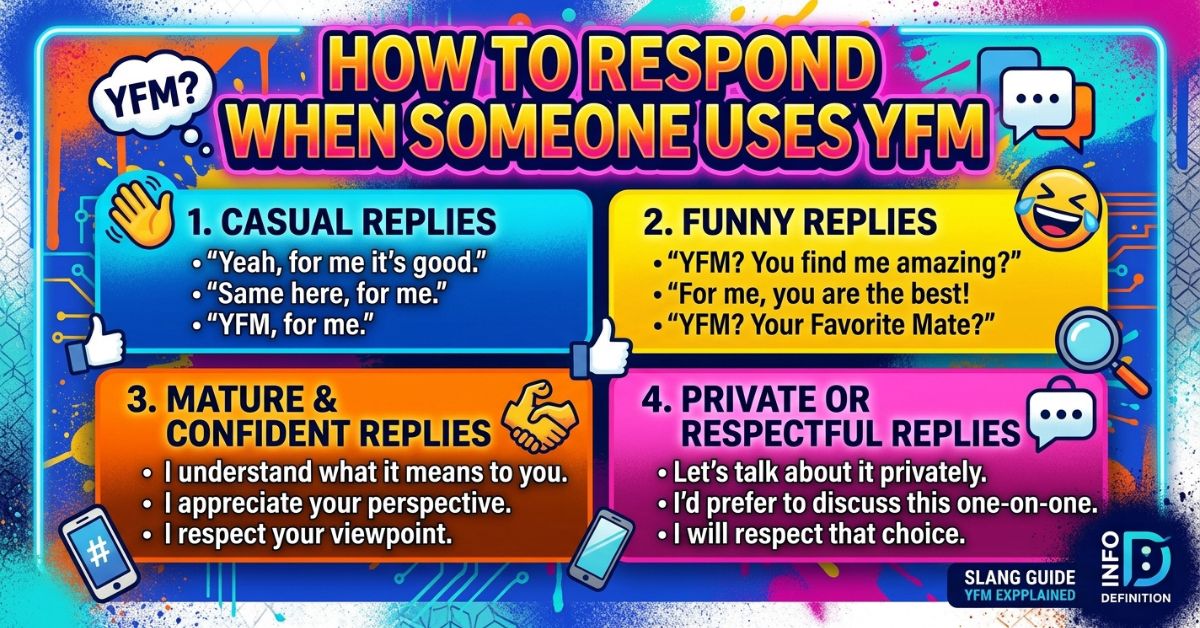
There isn’t one perfect response. Match your reply to the mood of the conversation.
Casual Replies
If you agree or understand, keep it simple:
- “Yeah, I get you.”
- “Definitely.”
- “Exactly.”
- “For sure.”
- “Absolutely.”
- “I feel you.”
Funny Replies
A playful conversation can handle a playful response:
- “Loud and clear.”
- “You’re speaking facts.”
- “Say less.”
- “You read my mind.”
- “I’m with you.”
Mature and Confident Replies
For a thoughtful conversation, use a clearer response:
- “I understand your point.”
- “That makes sense.”
- “I agree with you.”
- “I can relate to that.”
- “You have a valid point.”
Private or Respectful Replies
When someone shares something personal, respond with care:
- “I understand how you feel.”
- “I hear you.”
- “That makes sense to me.”
- “I can understand where you’re coming from.”
- “Thanks for explaining that.”
If you aren’t sure what the person means, there’s nothing wrong with asking:
“What do you mean by YFM?”
A clear question is better than an awkward guess.
Regional and Cultural Usage
YFM meaning in text appears in online English across different regions. However, familiarity with the expression can vary between communities and age groups.
Western Culture
YFM is commonly associated with casual speech, texting, music, sports culture, gaming, and social media. Younger users may recognize it quickly.
Asian Culture
English-speaking users across Asian online communities may encounter YFM through global social platforms. However, people who don’t regularly use internet slang may prefer the full phrase.
Middle Eastern Culture
English internet slang is common among many users who communicate on global social platforms. YFM may appear in casual chats, comments, and DMs, while formal communication usually favors standard English.
Global Internet Usage
Online slang travels quickly. A phrase that begins in spoken conversation can move into music, memes, gaming, social media, and messaging apps within a short time.
Still, context remains the key. YFM has one dominant meaning in ordinary texting, but other meanings can exist in specific communities or subjects.
Frequently Asked Questions
What does YFM mean in text?
YFM usually means “You Feel Me?” It asks whether someone understands, relates to, or agrees with what was said.
Is YFM positive or negative?
YFM is neither automatically positive nor negative. Its tone depends on the message, relationship, and context.
Can YFM have more than one meaning?
Yes. In ordinary texting, “You Feel Me?” is the main meaning, but YFM can represent other names or terms in specific contexts.
Is YFM rude?
Usually, no. It’s informal slang, although the tone can sound challenging if someone uses it during an argument.
Should I use YFM at work?
Generally, no. Use clearer phrases such as “Does that make sense?” or “Are we on the same page?” in professional settings.
Is YFM popular on social media?
Yes. YFM appears in casual posts, comments, DMs, group chats, and other informal online conversations.
How do I reply to YFM?
You can reply with “Yeah,” “Exactly,” “I get you,” “Definitely,” or another response that matches the tone of the conversation.
Read More : GNG Meaning: What It Really Means in Text, Slang, and Social Media
Conclusion
YFM meaning in text is a short but expressive piece of texting slang. In most casual conversations, it means “You Feel Me?” The sender usually wants to know whether you understand, relate to, or agree with their point.
You may see YFM in text messages, Instagram DMs, Snapchat chats, TikTok comments, gaming communities, and group conversations. Its tone can range from playful to emotional, depending on the surrounding message.
The easiest way to understand YFM is to look at the sentence before it. If someone shares an opinion and adds “YFM?”, they’re probably asking, “Do you get what I mean?” If the conversation feels personal, they may also be looking for empathy or shared understanding.
Use YFM with people who are comfortable with casual slang. For work, school, or formal communication, stick with clear and complete phrases.

Axel Miles is a writer and language researcher at Magazine Zeto, focused on explaining text meanings, slang, acronyms, and online expressions. Axel creates clear, practical guides that help readers understand modern digital language, with a focus on accuracy, context, and easy-to-follow explanations for everyday communication.